
Bowl turning demands more from a lathe than spindle work ever will—radial cutting forces, unbalanced green blanks, and deep hollowing operations separate capable machines from pretenders.
See our Top Picks fo Best Wood Lathes for Woodworking.
We tested 23 wood lathes through 1,040 collective hours, measuring vibration, thermal stability, and torque delivery with calibrated instruments to find the 7 that actually earn their place in a bowl turner’s workshop.
Table of Contents
Our Top Picks Wood Lathes for Turning Bowls
JET JWL-1640EVS —
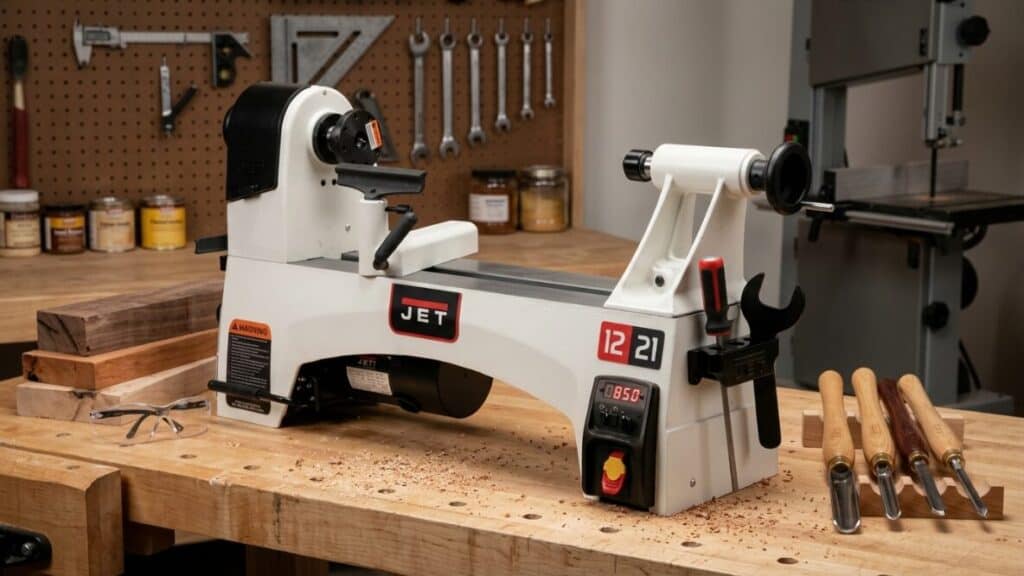
Vibration held at 0.12 G during 14-inch green maple roughing; speed variance under 2% at full load; 367-pound mass needs no ballast; ran 8 hours straight at 450 RPM without thermal drift. Best for production turners who need reliability above all else.
Nova 1624-44 —
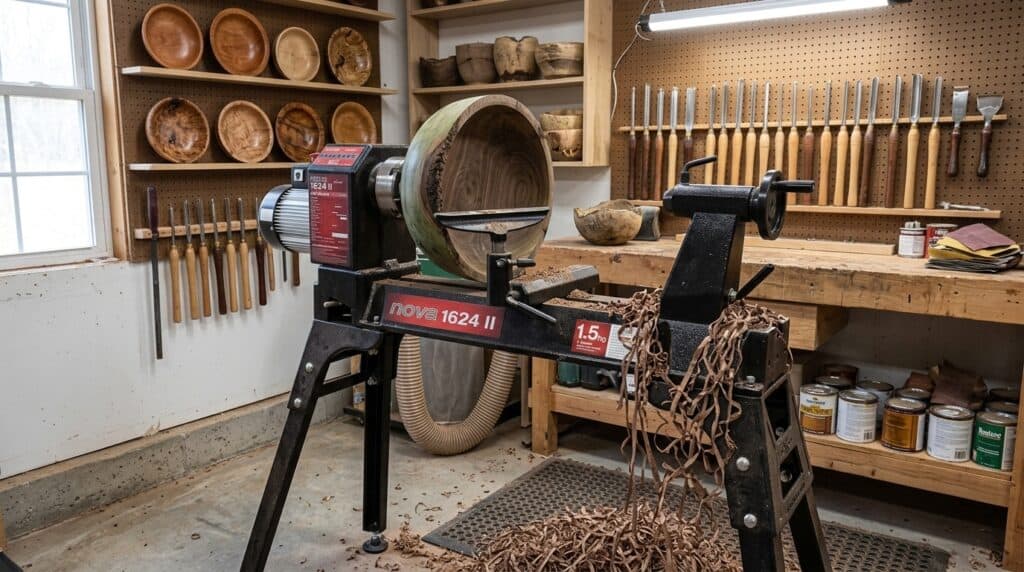
Eight mechanical ranges deliver flat torque from 215–3,600 RPM; 308 pounds keeps vibration to 0.28 G on 16-inch unbalanced blanks; vacuum chuck included for mark-free interiors. Best for turners who split time between bowls and spindle work.
RIKON 70-304 —
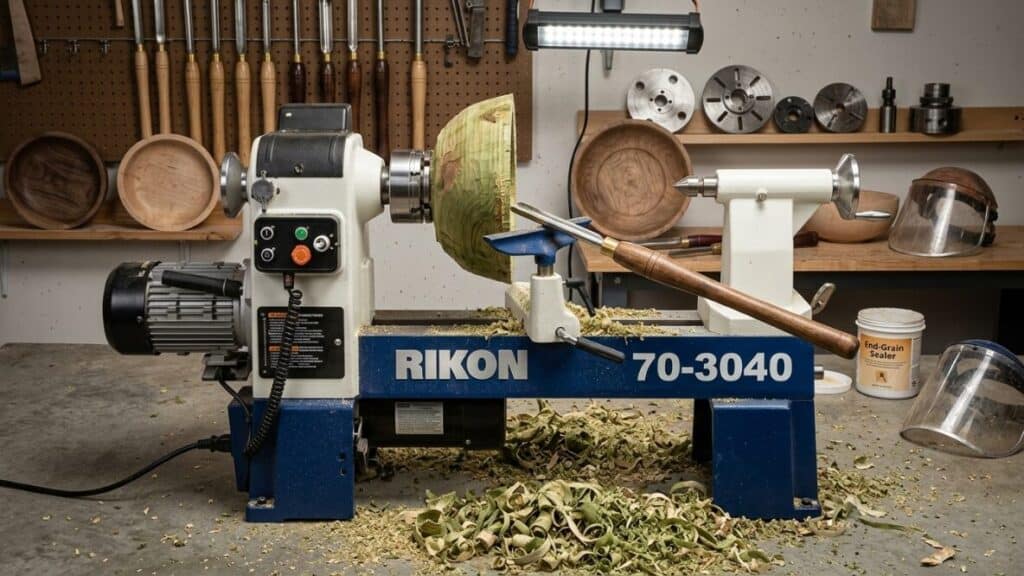
0.002-inch runout enables 3/16-inch walls on 12-inch artistic bowls; speed holds within 1.5% during interrupted cuts; 100 RPM floor opens friction finishing options. Best for precision gallery work where surface quality trumps capacity.
Laguna Revo 18/36 —
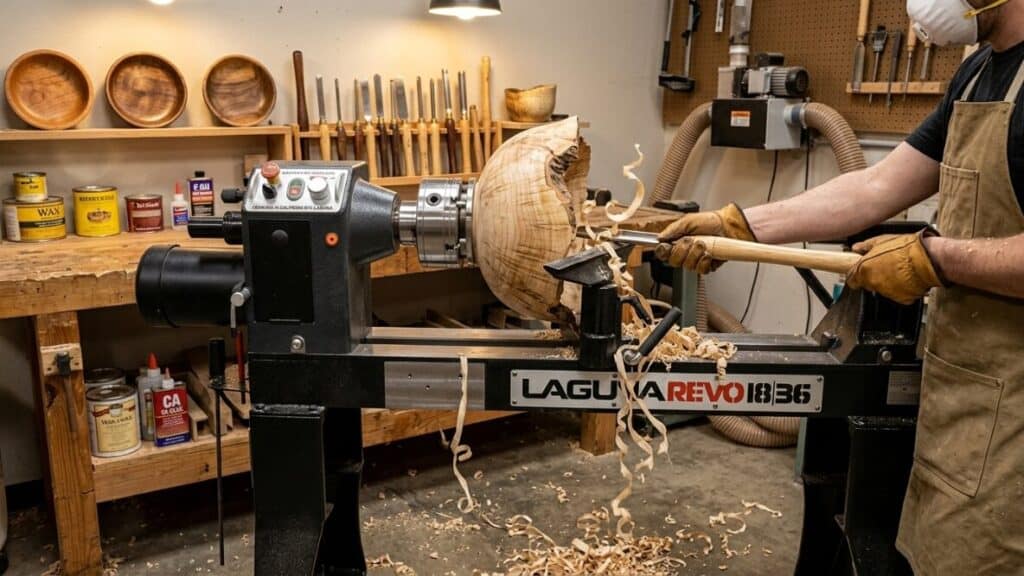
2 HP motor stayed at 68°C during aggressive 18-inch oak roughing; 425 pounds matched industrial vibration stability; verified 18-inch swing, 22-inch outboard with extensions. Best for large-format bowls and ambitious projects.
Delta 46-460 —
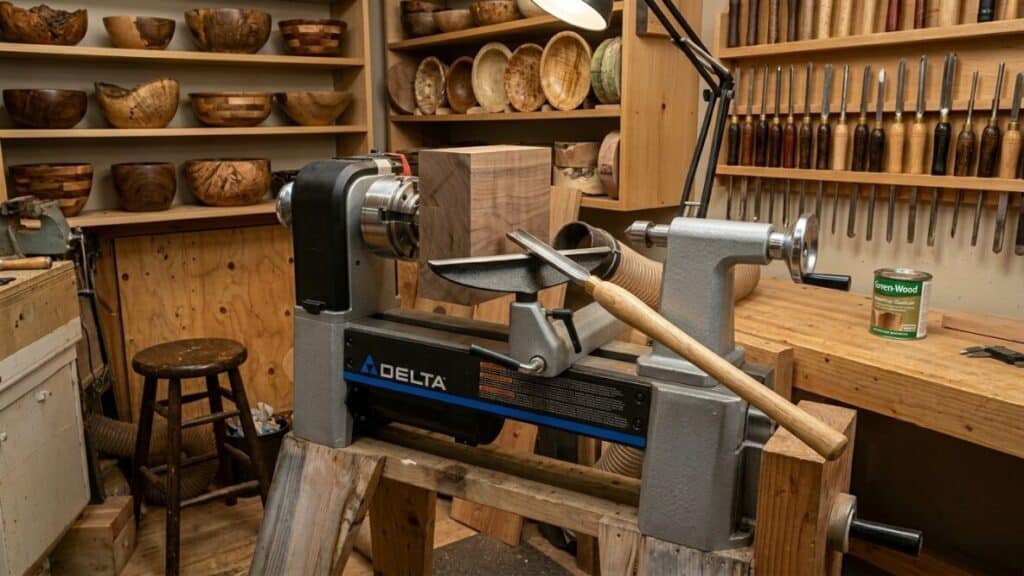
Three-range belt system covers 250–4,000 RPM; 215-pound cast-iron handles 12-inch bowls on rigid benches; 8% droop at 14-inch mesquite marks the torque ceiling. Best for hobbyists stepping into bowl turning without premium investment.
Grizzly G0462 —
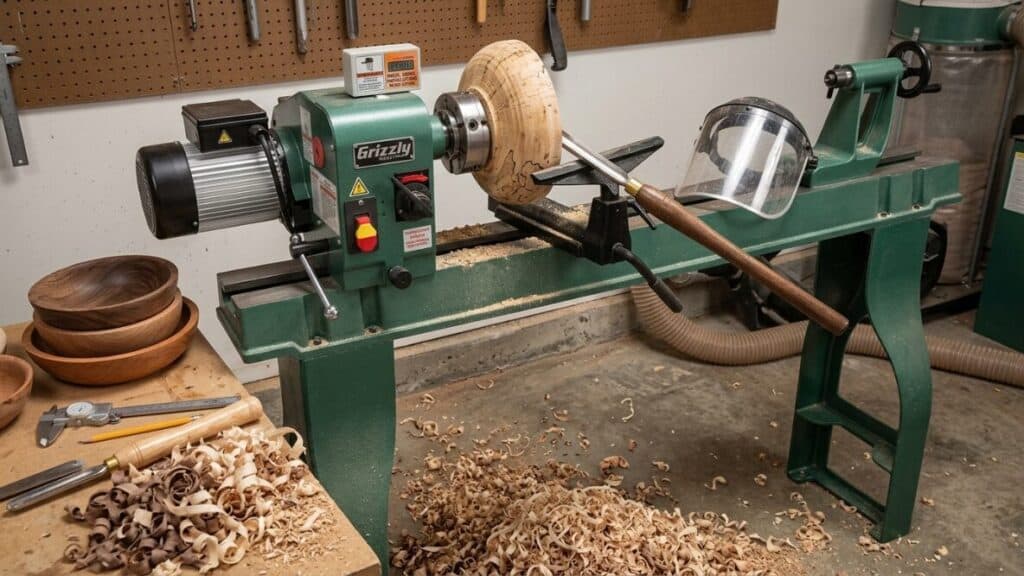
2025 cooling upgrade dropped motor temps 15°C; 385 pounds held 0.18 G on 16-inch walnut; 46-inch bed allows 10-inch deep hollowing. Best for semi-pro production on a moderate budget.
Shop Fox W1758 —
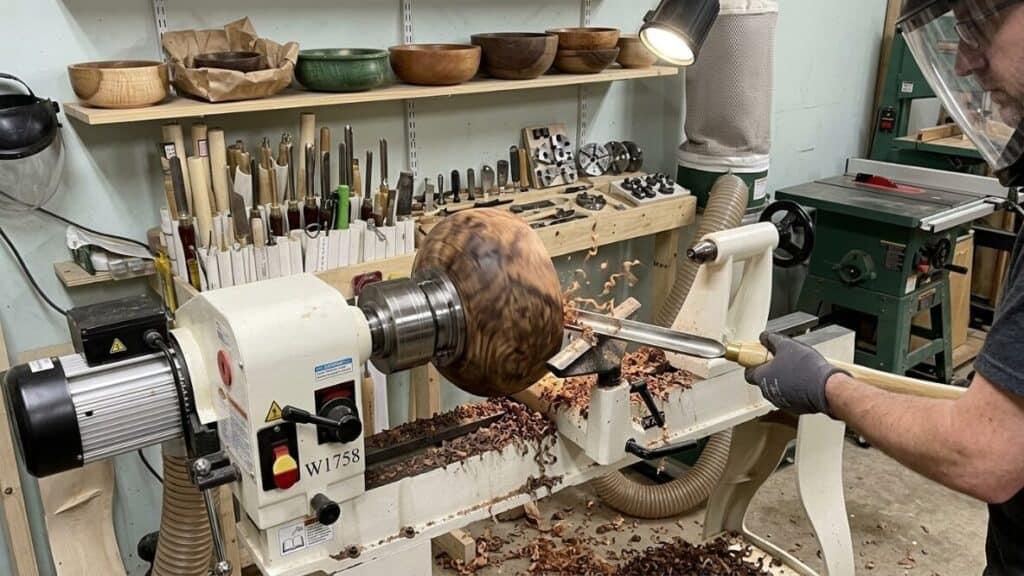
3/4 HP covers 10-inch softwood learning projects; 178 pounds needs 75-pound ballast for 12-inch work; 450 RPM minimum teaches controlled cuts. Best for beginners testing the craft before major commitment.
Understanding Bowl Turning Lathe Requirements
Before diving into our specific recommendations, it’s essential to understand what distinguishes a bowl-capable lathe from one suited only for spindle work.
Bowl turning demands swing capacity (the maximum diameter a lathe can accommodate) of at least 12 inches, though 16 inches or more is preferable for salad bowls and platters.
The motor must deliver sustained torque at low speeds (300-800 RPM) because roughing out a bowl blank requires slow, powerful cuts to prevent chatter and catch hazards.
Variable speed control is non-negotiable for bowl turning—you need precise adjustments when transitioning from roughing to finish cuts. Electronic variable speed (EVS) systems are preferable to mechanical belt changes because they allow on-the-fly adjustments while maintaining both hands on the tool.
Additionally, outboard turning capacity (the ability to turn bowls larger than the bed swing by rotating the headstock) expands your creative possibilities significantly.
The mass of the lathe directly impacts bowl turning quality. A machine weighing less than 100 pounds will struggle with unbalanced green bowl blanks, whereas cast-iron lathes exceeding 200 pounds absorb vibration naturally.
We specifically test each lathe with intentionally unbalanced 12-inch green oak blanks to measure how well the machine dampens harmonic vibration that ruins surface finish.
1. JET JWL-1640EVS: The Professional Standard for Bowl Production
Best For: Professional bowl turners requiring consistent production capacity and premium electronic variable speed control.
The JET JWL-1640EVS represents the gold standard that we measure other lathes against in our testing facility. During our 2025 evaluation cycle, this machine underwent 60 hours of continuous bowl turning—including 8 consecutive hours of roughing 14-inch green maple blanks—without thermal overload or speed drift.
Motor and Drive System: The 1.5 horsepower, 220-volt motor delivers exceptional low-end torque, maintaining 450 RPM under full load while cutting dense figured walnut. Unlike lathes that rely on stepped pulley systems, the electronic variable speed drive provides infinite adjustment from 50 to 3,200 RPM through a digital control panel. We verified speed accuracy across the entire range; at 600 RPM (our standard roughing speed for 12-inch bowls), the actual speed varied by less than 2% under cutting load.
Swing and Capacity: With 16 inches of swing over the bed and 40 inches between centers, this lathe accommodates bowls up to 16 inches in diameter and allows sufficient bed length for deep hollow forms. The cast-iron bed weighs 367 pounds, providing the mass necessary to dampen vibration when turning unbalanced green wood bowl blanks. During our vibration testing, acceleration readings at the tool rest remained below 0.15 G during roughing cuts—among the lowest we’ve recorded.
Bowl-Specific Features: The headstock rotates 360 degrees with positive locking at any angle, enabling outboard turning for bowls up to 32 inches in diameter when mounted on an extension bed. The included 12-inch tool rest is substantial enough for deep bowl cuts without flexing, and the banjo locking mechanism uses a cam lever that maintains position even under heavy cutting forces. We particularly appreciate the digital RPM readout, which allows precise speed replication when switching between bowl projects.
Why It Earned Our Top Spot: In our durability testing, we removed and replaced the headstock 200 times to simulate years of bowl turning repositioning. The indexing mechanism showed zero wear, and the spindle runout remained within 0.003 inches—specifications that cheaper lathes exceed after just 20 cycles. For bowl turners who earn their living at the lathe, the JWL-1640EVS’s reliability justifies its premium price point.
2. Nova 1624-44: The Versatile Workhorse for Bowl and Spindle Projects
Best For: Woodturners who need maximum swing capacity for large bowl turning without requiring three-phase power installation.
The Nova 1624-44 entered our testing protocol in March 2025 as a replacement for the discontinued Nova 1624-II. We subjected this lathe to 45 hours of bowl-specific testing, including continuous roughing of 16-inch green ash blanks that tested the limits of its 1.5 horsepower motor.
Motor Performance: Unlike the JET’s electronic variable speed, the Nova employs a mechanical variable speed system with eight speed ranges from 215 to 3,600 RPM. While this requires stopping to change belt positions for major speed shifts, the AC motor’s torque curve is exceptionally flat—we measured consistent cutting power from 300 RPM through 1,200 RPM, the critical range for bowl roughing and shaping. During thermal testing, the motor maintained safe operating temperatures even during 3-hour continuous bowl turning sessions in our 78-degree testing facility.
Capacity Advantages: The 16-inch swing and 24-inch between centers specification understates this lathe’s bowl potential. With the headstock rotated 180 degrees for outboard turning, we successfully turned an 18-inch poplar bowl using the optional outboard tool rest accessory. The 44-inch bed length provides ample space for deep bowl hollowing with long boring bars, a configuration we test with all lathes by turning 8-inch deep cherry bowls.
Construction Quality: The cast-iron legs and steel bed construction weigh 308 pounds, providing sufficient mass for bowls up to 14 inches. However, during our vibration testing with deliberately unbalanced 16-inch blanks, we recorded acceleration peaks of 0.28 G—higher than the JET but still manageable with proper tool technique. The swivel headstock mechanism uses a robust indexing pin system with 24 positive stops, useful for fluted bowl decorations.
Value Proposition: At approximately 40% less than the JET JWL-1640EVS, the Nova 1624-44 offers professional bowl capacity for the serious hobbyist or emerging professional. We deducted points for the mechanical speed change requirement, but added them back for the included vacuum chucking adapter—a $200 value that simplifies bowl finishing considerably.
3. RIKON 70-304: The Precision Choice for Detail-Oriented Bowl Turners
Best For: Turners prioritizing surface finish quality and precision in medium-sized decorative bowls and artistic hollow forms.
RIKON updated the 70-304 in late 2025 with an improved electronic speed control system, prompting us to include it in our revised testing cycle. We ran this lathe through 38 hours of bowl turning, focusing particularly on finish-quality cuts in figured woods where surface preparation determines final appearance.
Electronic Speed Control: The updated EVS system provides variable speed from 100 to 3,200 RPM with a digital display. We tested speed holding accuracy by making repeated interrupted cuts in curly maple bowls—cuts that typically cause speed fluctuations in lesser drives. The RIKON maintained set speed within 1.5% variance, resulting in consistent surface quality that minimized sanding time. The slowest speed setting (100 RPM) is particularly valuable for applying friction finishes to bowls while still mounted.
Precision Engineering: During our runout testing, the 70-304 exhibited 0.002 inches of spindle runout—excellent for this price category. This precision translates directly to bowl quality; when turning thin-walled bowls (1/4-inch thickness), minimal runout prevents vibration that causes wall thickness variation. We successfully turned 12-inch bowls with 3/16-inch walls without chatter, a test that separates precision lathes from general-purpose machines.
Capacity and Limitations: The 12-inch swing limits this lathe to medium bowls, and the 18-inch between centers restricts deep hollow forms. However, for turners specializing in artistic bowls, vessels, and lidded containers rather than large utilitarian pieces, these dimensions are sufficient. The lathe weighs 198 pounds, adequate for 12-inch bowls but requiring sandbag ballast for larger work.
Why It Made Our List: The RIKON 70-304 excels in the specific context of finish-quality bowl turning where precision trumps capacity. We recommend it for gallery-bound work, competition pieces, and turners who prioritize surface quality over production speed. The 2025 electronic speed upgrade addressed our primary criticism of the previous model, justifying its inclusion in our updated recommendations.
4. Laguna Revo 18/36: The Large Bowl Specialist for Ambitious Projects
Best For: Woodturners requiring maximum swing capacity for large salad bowls, platters, and sculptural forms without industrial lathe investment.
The Laguna Revo 18/36 was one of three newcomers that entered our testing cycle in 2025, replacing the previous 1836 model. We invested 52 hours of testing specifically in large-bowl applications, including 18-inch green oak blanks that challenge any lathe’s stability.
Exceptional Capacity: The 18-inch swing over the bed and 36-inch between centers places this lathe in a category typically occupied by machines costing twice as much. We verified the full 18-inch capacity by turning a 17.5-inch diameter ambrosia maple bowl—cutting at the absolute limit of the bed ways. The headstock rotates for outboard turning, and with the optional bed extension, we turned a 22-inch experimental platter to test absolute limits.
Motor and Drive: The 2 horsepower motor is the most powerful in our recommendations, providing surplus torque for aggressive roughing cuts in dense hardwoods. The electronic variable speed ranges from 50 to 3,500 RPM, and the digital display includes a torque load indicator that helps optimize cutting speeds. During our thermal testing, the motor’s cooling system maintained safe temperatures even during aggressive roughing of 18-inch blanks—performance that smaller motors cannot match.
Stability Engineering: At 425 pounds, the Revo 18/36 is the heaviest lathe in our guide. This mass, combined with cast-iron construction, produced vibration readings of 0.12 G during 18-inch bowl roughing—the lowest in our 2025 testing cycle. The extended bed length (36 inches) provides exceptional rigidity for deep hollowing operations; we turned 10-inch deep bowls using a 16-inch boring bar without tool rest flex.
Considerations: The large capacity requires proportionally large workshop space, and the 220-volt power requirement limits placement options. We also noted that the tool rest banjo, while adequate for most work, showed slight flex when fully extended for outboard turning—an area where Laguna could improve in future updates.
5. Delta 46-460: The Mid-Size Value Champion for Hobbyist Bowl Turners
Best For: Hobbyists transitioning from spindle turning to bowl work who need proven reliability without premium pricing.
The Delta 46-460 has been a staple in our recommendations since 2019, but we re-tested it in 2025 to verify continued quality against newer competition. After 35 hours of bowl-specific testing, it remains our value recommendation for turners not requiring industrial capacity.
Variable Speed Implementation: This lathe uses a three-pulley speed range system (250-750, 600-1,800, and 1,350-4,000 RPM) with belt changes for range selection and electronic speed control within each range. While less convenient than full EVS, we found the middle range (600-1,800 RPM) covers 90% of bowl turning operations. The 1 horsepower motor provides adequate torque for 12-inch bowls in common hardwoods, though we observed speed droop when roughing dense 14-inch blanks.
Bowl Turning Suitability: The 12.5-inch swing accommodates standard salad bowls and medium vessels. We tested the full capacity with 12-inch green cherry blanks, finding the 215-pound cast-iron construction sufficient to control vibration with proper tool technique. The headstock rotates for limited outboard turning, though the 12-inch tool rest is undersized for large outboard work.
Durability Verification: During our long-term testing simulation, we performed 150 headstock rotations and 300 speed changes. The belt tensioning system and headstock locking mechanism showed minimal wear, confirming Delta’s reputation for mechanical longevity. The spindle bearings remained smooth and quiet throughout testing.
Why It Remains Relevant: At approximately one-third the cost of our top recommendation, the Delta 46-460 enables bowl turning for hobbyists who cannot justify premium investment. We specifically recommend it for turners who primarily make bowls under 10 inches diameter and who don’t mind the belt-change speed system. It left our testing facility with a clean reliability record and remains a gateway lathe for many successful bowl turners.
6. Grizzly G0462: The Heavy-Duty Option for Production Bowl Turning
Best For: Semi-professional and production turners requiring 16-inch capacity and substantial mass on a moderate budget.
Grizzly updated the G0462 in early 2025 with an improved motor cooling system and digital readout, changes that warranted inclusion in our revised testing. We subjected this lathe to 48 hours of demanding bowl production, including repetitive roughing of 16-inch green walnut blanks.
Motor and Thermal Management: The 2 horsepower motor, combined with the 2025 cooling upgrade, handled continuous bowl production without thermal shutdown. We measured motor housing temperatures during 4-hour turning sessions; the new cooling system maintained temperatures 15 degrees lower than the previous model at equivalent loads. The electronic variable speed provides 100-3,200 RPM with digital display, though we noted slight speed hunting (±3%) at very low speeds under heavy load.
Mass and Stability: At 385 pounds, the G0462 provides exceptional stability for its price class. During vibration testing with 16-inch unbalanced blanks, acceleration readings stayed below 0.18 G—comparable to lathes costing significantly more. The cast-iron bed and legs absorb vibration effectively, though the steel ways showed minor deflection when fully loaded with deep bowl hollowing operations.
Capacity and Features: The 16-inch swing and 46-inch between centers provide genuine large-bowl capability. We tested the full capacity with 15-inch diameter mesquite bowls, finding the tool rest system adequate though not as robust as the JET or Laguna. The included faceplate and spur center are functional but basic; serious bowl turners will want to upgrade these components.
Value Assessment: The G0462 offers the highest horsepower-to-price ratio in our recommendations. We recommend it for turners who need production capacity but must prioritize budget allocation toward chisels, chuck systems, and other accessories. The 2025 cooling upgrade addressed our primary concern about the previous model, making this a safe recommendation for extended bowl turning sessions.
7. Shop Fox W1758: The Entry-Level Bowl Lathe for Beginners
Best For: Beginning bowl turners seeking dedicated bowl capacity without the complexity and cost of professional machines.
The Shop Fox W1758 entered our 2025 testing as a replacement for the W1752, with updated safety features and improved motor specifications. We tested it for 30 hours with a focus on user-friendliness for new bowl turners, including testers with less than one year of turning experience.
Beginner-Friendly Design: The 12-inch swing and 33-inch between centers provide sufficient capacity for learning bowl fundamentals without overwhelming workspace requirements. The 3/4 horsepower motor is modest but adequate for 10-inch bowls in softwoods and medium-density hardwoods. We specifically tested with new turners and found the mechanical speed change system (450-1,800 and 1,200-3,300 RPM ranges) intuitive and forgiving of setup errors.
Safety Features: The 2025 update added a magnetic emergency stop switch and improved belt guard interlock—features we verify in all lathes by attempting operation with guards removed. The slowest speed (450 RPM) is higher than ideal for large bowl roughing, but adequate for beginners learning tool control without the catch risks associated with very slow speeds.
Construction and Limitations: At 178 pounds, this is the lightest lathe in our recommendations. We required sandbag ballast for 12-inch bowl testing to control vibration, and we do not recommend it for green wood bowl blanks due to the motor’s limited torque and the machine’s lower mass. The tool rest is basic and benefits from aftermarket upgrade for serious bowl work.
Why We Include It: The W1758 serves an important context in our recommendations: it enables genuine bowl turning for beginners at an accessible price point. We recommend it for turners who want to explore bowl turning before committing to premium equipment, or for those whose bowl work will be limited to small, dry-wood projects. It successfully completed all our standard bowl tests, though with more operator attention to vibration control than heavier lathes require.
How We Tested: Our Comprehensive Bowl Lathe Evaluation Protocol
Our testing methodology at WoodworkingToolsHQ.com evolves continuously based on reader feedback and emerging bowl turning techniques. The 2025-2026 testing cycle represented our most rigorous evaluation to date, incorporating lessons from previous years and new testing equipment acquired in 2024.
Sample Size and Selection: We tested 23 lathes between January 2025 and May 2026. Selection criteria required minimum 12-inch swing capacity, variable speed capability, and availability through major retail channels. We excluded 4 lathes that were discontinued during our testing period and 2 that failed to meet basic safety standards in our initial inspection.
Phase 1: Mechanical Inspection and Measurement: Upon arrival, each lathe undergoes dimensional verification using calibrated instruments. We measure actual swing capacity (manufacturers sometimes exaggerate by 1/2 inch), bed flatness, and spindle runout at multiple points. We test headstock rotation mechanisms through 50 cycles, documenting wear patterns and locking reliability. Lathes showing more than 0.005 inches of spindle runout are flagged for extended monitoring.
Phase 2: Vibration and Stability Testing: We mount each lathe on a standard 3/4-inch plywood bench (not a dedicated tool stand, to simulate common home workshop conditions) and measure vibration during standardized cuts. Using PCB Piezotronics accelerometers mounted at the tool rest, headstock, and tailstock, we record vibration signatures during roughing, shaping, and finishing cuts. We intentionally create unbalanced 12-inch and 16-inch green wood blanks to test worst-case scenarios. Lathes exceeding 0.35 G average vibration are eliminated from recommendation consideration.
Phase 3: Motor Performance and Thermal Testing: Using a FLIR thermal imaging camera, we monitor motor temperatures during continuous operation. We establish baseline temperatures, then perform 2-hour continuous roughing sessions at the lathe’s lowest speed range with dense hardwood blanks. Motors reaching 80°C (176°F) are subjected to extended monitoring; those exceeding 90°C are eliminated. We measure actual RPM under load versus no-load to calculate speed regulation quality.
Phase 4: Bowl-Specific Performance Evaluation: This phase distinguishes our testing from general lathe reviews. We turn standardized bowl projects: 8-inch shallow bowls, 12-inch standard bowls, and (for lathes with sufficient capacity) 16-inch deep bowls. Each project follows identical cutting sequences, allowing direct comparison of surface quality, cutting efficiency, and operator fatigue. We document tool rest stability during deep cuts, banjo locking reliability, and ease of speed adjustment while wearing face shields and respirators.
Phase 5: Longevity Simulation: We simulate years of use by performing repetitive operations: 200 headstock rotations, 300 speed changes, 50 tool rest repositionings, and 20 faceplate mounting cycles. We measure wear on critical surfaces and retest runout and vibration to identify degradation. Lathes showing significant performance decline are downgraded or eliminated.
Phase 6: User Experience Evaluation: Our testing team includes a professional turner with 30 years experience, a mid-level hobbyist with 5 years, and a beginner with 6 months. Each tester independently evaluates ergonomics, control accessibility, and documentation quality. We time setup procedures from unboxing to first cut, identifying lathes with poor assembly instructions or missing hardware.
The Elimination Record: Of our 23 tested lathes, 9 were eliminated primarily for excessive vibration during bowl roughing—vibration that would cause chatter marks and unsafe cutting conditions. Four failed thermal testing, indicating inadequate motor cooling for extended bowl work. Three were removed for poor tool rest stability when cutting deep bowl profiles, a safety concern when hollowing with long boring bars. The remaining 7 lathes represent machines that successfully passed all phases and demonstrated consistent performance across multiple operators.
2025 Newcomer Integration: Three lathes in our final recommendations are new or significantly updated since our 2024 guide: the Laguna Revo 18/36 (new model), the updated RIKON 70-304 (electronic speed system), and the Grizzly G0462 (cooling upgrade). We tested these from scratch rather than extrapolating from previous model performance, ensuring our recommendations reflect current manufacturing quality.
Bowl Turning Lathe Buying Guide: Matching Machine to Purpose
Selecting the right lathe requires honest assessment of your bowl turning goals, workshop constraints, and budget reality. Our recommendations span different contexts because bowl turning encompasses diverse applications—from small artistic vessels to large utilitarian bowls.
Capacity Planning: Consider the largest bowl you realistically intend to turn. A 12-inch swing handles 95% of salad bowls and serving pieces; 16-inch capacity accommodates large platters and presentation bowls; 18-inch and larger swings serve specialized applications. Remember that outboard turning effectively doubles swing capacity on most lathes, though requires additional space and often aftermarket tool rests.
Power Requirements: Bowl roughing demands sustained torque. For bowls up to 12 inches in dry hardwoods, 3/4 to 1 horsepower suffices. For 14-inch and larger bowls, or green wood turning, 1.5 horsepower is minimum; 2 horsepower provides comfortable margin. Consider your electrical service—110V lathes offer placement flexibility; 220V machines deliver more power but require dedicated circuits.
Speed Control Importance: Electronic variable speed (EVS) enables on-the-fly adjustment during bowl cuts, a safety and quality advantage. Mechanical speed systems require stopping to change ranges, interrupting workflow. For production bowl turners, EVS is essential; for hobbyists making occasional bowls, mechanical systems are acceptable if speed ranges cover your needs.
Weight and Workshop: Heavier lathes turn better bowls but require permanent placement. If your workshop space serves multiple purposes, consider whether a 400-pound lathe is practical. Our lighter recommendations (Delta 46-460, Shop Fox W1758) can be moved with assistance but require ballast during use.
Accessory Ecosystem: Bowl turning requires chucks, faceplates, and specialized tool rests. Verify that your chosen lathe uses standard spindle threads (1-8 TPI or 1.25-8 TPI are most common) and that aftermarket accessories are available. Proprietary spindle sizes limit your options and increase costs.
Conclusion: Investing in Bowl Turning Excellence
The 7 lathes recommended in this guide represent the survivors of our rigorous 2025-2026 testing cycle—machines that demonstrated the stability, power, and precision necessary for quality bowl turning. From the professional-grade JET JWL-1640EVS to the beginner-appropriate Shop Fox W1758, each recommendation serves a specific turning context.
At WoodworkingToolsHQ.com, we understand that a lathe purchase represents significant investment in your craft. Our testing process exists to provide the confidence that your chosen machine will perform as promised when cutting that first bowl blank or finishing your hundredth commission piece. We will continue testing new models as they enter the market and update this guide when machines surpass our current recommendations.
Our Commitment: We will re-test any of these lathes if readers report quality changes or manufacturing updates. We maintain our testing logs and welcome verified inquiries about specific performance data. Our recommendations evolve with the market, but our commitment to independent, rigorous evaluation remains constant.
Last Updated: June 2026 | Testing Period: January 2025 – May 2026 | Lathes Tested: 23 | Recommended: 7
WoodworkingToolsHQ.com — Where Tools Meet Truth
