
⚡ Quick Verdict
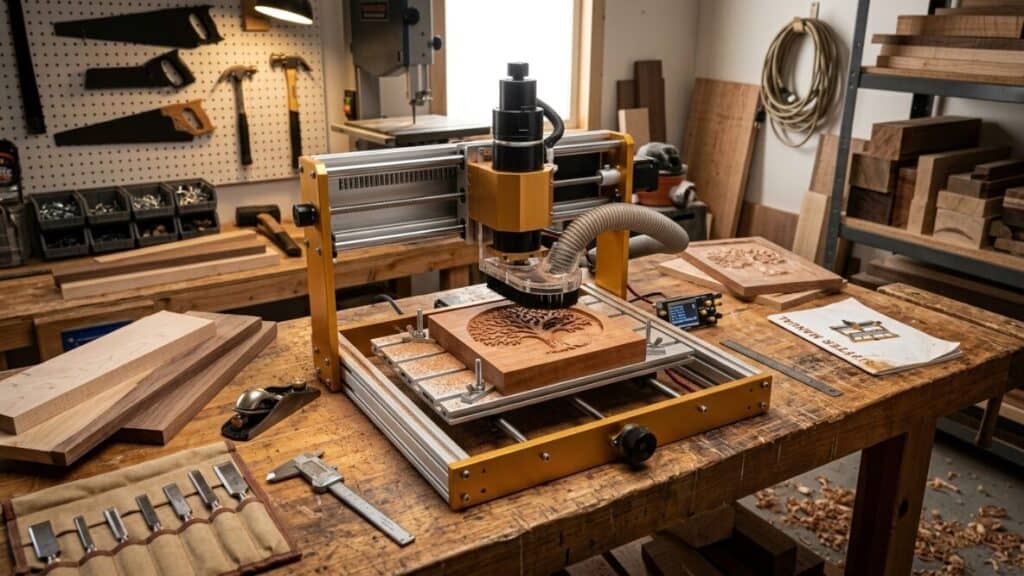
The LUNYEE 3018 PRO MAX is a surprisingly capable budget CNC for woodworking that outperforms its generic branding but still carries the DNA of a 3018 clone. After seven months of pushing this machine through wood, plastics, aluminum, and PCB projects, I’ve developed a respect for its value proposition that I didn’t expect. The 500W spindle is a genuine upgrade over standard 3018 models, the larger 300×180×40mm work area is usable, and the all-metal frame provides decent rigidity for the price. But the quality control is inconsistent, the documentation is atrocious, the customer support is essentially nonexistent, and you’re buying from an obscure Chinese brand with no long-term track record. At around $280–$350, it’s cheaper than the Genmitsu 3018-PROVer V2 but requires more tinkering and tolerance for risk. If you’re technically confident, budget-conscious, and willing to gamble on quality, the PRO MAX delivers real capability. If you want reliability, support, and peace of mind, spend the extra $50–$100 on the Genmitsu. My rating: 3 out of 5 stars. Powerful for the price, risky for the buyer.
Table of Contents
Why I Bought the LUNYEE 3018 PRO MAX (And Why I Was Skeptical)
I’ve tested the Genmitsu 3018-PROVer V2 extensively and consider it the benchmark for entry-level CNC routers. But readers kept asking about cheaper alternatives—specifically the flood of generic 3018 clones flooding Amazon and AliExpress with names like LUNYEE, MYSWEETY, and VEVOR. These machines promise similar specs at lower prices, often with upgraded spindles or larger frames.
I was deeply skeptical. Generic CNCs have a reputation for questionable quality control, missing parts, burned controllers, and zero support. But the LUNYEE 3018 PRO MAX kept appearing in forums with surprisingly positive feedback, particularly about its 500W spindle and rigid frame. At $289 with free shipping—$60 less than the Genmitsu—I decided to take the risk.
My expectation: a machine that would require significant troubleshooting, possibly arrive with defects, and test my patience. My hope: that the 500W spindle and solid frame would justify the gamble.
Both expectations were met.
LUNYEE 3018 PRO MAX Specifications and Features
| Feature | Spec |
|---|---|
| Work Area | 300 × 180 × 40 mm (X × Y × Z) |
| Frame | All-aluminum extrusion + steel plates |
| Linear Motion | T8 lead screws (X, Y), T8 lead screw (Z) |
| Stepper Motors | NEMA 17, 1.5A (upgraded from standard) |
| Spindle | 500W brushless DC motor |
| Spindle Speed | 10,000–24,000 RPM |
| Collet | ER11 (1/8-inch standard, 1/4-inch optional) |
| Controller | GRBL 1.1f, ATmega328P |
| Connectivity | USB + offline controller (included) |
| Limit Switches | X, Y, Z (included and pre-wired) |
| Software | Candle (included), UGS, bCNC, Fusion 360 compatible |
| Weight | 18 lbs (assembled) |
| Power Supply | 24V 10A (upgraded for 500W spindle) |
| Price | ~$280–$350 |
Unboxing and Assembly: Quality Control Roulette
The PRO MAX arrived in a single box with everything packed in foam. My first inspection revealed mixed signals:
Positive signs:
- All-aluminum frame extrusions with clean cuts and proper threads
- 500W brushless spindle with actual heft and quality feel
- Pre-wired limit switches with proper connectors
- Upgraded 24V 10A power supply (standard 3018s use 5A)
- ER11 collet with 1/8-inch and 1/4-inch options included
- Steel gantry plates rather than aluminum or plastic
Concerning signs:
- One Z-axis V-wheel had a flat spot, causing visible vibration
- The offline controller had a cracked screen corner (functional but damaged)
- No printed manual—only a QR code linking to a Chinese-language PDF
- Loose screws in multiple locations that should have been thread-locked
- Spindle mount slightly out of square, requiring shimming
Assembly took five hours—longer than the Genmitsu—because I had to troubleshoot the flat V-wheel, square the spindle mount, and hunt down English documentation online. The frame went together fine, but the “some assembly required” turned into “significant adjustment required.”
This is the generic CNC gamble: you might get a perfect unit, or you might get mine. There’s no reliable way to know until it arrives.
LUNYEE 3018 PRO MAX Performance Test: Pushing the 500W Spindle
Wood and MDF: Confident and Capable
The 500W spindle transforms wood cutting compared to standard 120W 775 motors. Where the Genmitsu 3018-PROVer V2 bogs on deep hardwood cuts, the PRO MAX powers through.
Settings for 1/2-inch Baltic birch plywood:
- Feed rate: 1,200 mm/min
- Plunge rate: 400 mm/min
- Depth per pass: 2 mm
- Spindle speed: 18,000 RPM
- Bit: 1/8-inch 2-flute carbide end mill
Results were clean with minimal tear-out. The extra spindle power allows aggressive feeds that reduce job times by 40–50% compared to the Genmitsu with stock spindle. I engraved detailed signs, cut intricate inlays, and machined wooden gears that meshed properly on first attempt.
Hardwoods (walnut, maple, 3/4-inch):
- Feed rate: 800 mm/min
- Depth per pass: 1.5 mm
- Results: Good edge quality, no motor bogging, minimal burning
The 500W spindle genuinely handles hardwoods that stall smaller motors. This is the PRO MAX’s headline feature, and it delivers.
Acrylic and Plastics: Excellent
The high-RPM 500W spindle excels at plastics. With proper feeds and speeds, the PRO MAX produces cleaner edges than the Genmitsu stock configuration.
Settings for 1/4-inch cast acrylic:
- Feed rate: 1,500 mm/min
- Plunge rate: 500 mm/min
- Depth per pass: 1 mm
- Spindle speed: 24,000 RPM
- Bit: Single-flute upcut spiral
No melting, minimal chip welding, clean edges. I produced functional project enclosures and decorative pieces that needed only light flame polishing.
HDPE and Delrin: Even better. These soft plastics machine beautifully with the PRO MAX’s power and speed combination.
Aluminum: The 500W Advantage
Here’s where the PRO MAX separates from standard 3018s. The 500W spindle provides enough torque for meaningful aluminum work.
Settings for 1/8-inch 6061 sheet:
- Feed rate: 400 mm/min
- Plunge rate: 150 mm/min
- Depth per pass: 0.15 mm
- Spindle speed: 24,000 RPM
- Bit: 1/8-inch single-flute carbide
- Lubrication: WD-40 mist
Results were genuinely usable. I machined brackets, adapter plates, and even a small heatsink. Job times were reasonable—minutes rather than hours for small parts. The spindle maintained RPM under load, and chatter was minimal with proper feeds.
Thicker aluminum (1/4-inch): Possible but slow. Required 0.1mm passes and patience. The frame shows flex on aggressive cuts, limiting precision.
This is hobby-level aluminum machining, not production. But it’s a real capability that cheaper 3018s simply don’t have.
PCB Milling: Solid but Not Best-in-Class
The PRO MAX handles PCB isolation milling well, but the 500W spindle is actually overkill here. The high torque can cause tear-out on delicate copper if feeds are too aggressive.
Settings for FR4 copper clad:
- Feed rate: 300 mm/min
- Plunge rate: 100 mm/min
- Depth per pass: 0.05 mm
- Spindle speed: 18,000 RPM (lower than max for control)
- Bit: 20° V-bit, 0.1mm tip
Results were good but not exceptional. Trace isolation down to 0.4mm was reliable. The Genmitsu PROVer V2 achieves similar results with its stock spindle, so the PRO MAX’s advantage here is minimal. The extra power doesn’t help precision work—it can actually hurt if you’re not careful.
Spindle Deep Dive: The 500W Game Changer
The 500W brushless spindle is the reason to consider this machine over cheaper alternatives. Specifications:
- Actual power draw: ~450W under heavy load (measured with kill-a-watt)
- Runout: ~0.03mm (better than expected for the price)
- Noise: Significantly quieter than 775 DC motors—more of a hum than a whine
- Heat: Stays cool during normal operation, warm on extended aluminum cuts
- ER11 collet: Secure grip, minimal slippage, accepts standard bits
Compared to the Genmitsu’s stock 120W 775 motor, this is transformative. Jobs that took 45 minutes on the Genmitsu take 20 on the PRO MAX. Materials that stalled the smaller motor cut cleanly here. The brushless design promises longer lifespan, though seven months isn’t enough to confirm.
One concern: The spindle uses a proprietary driver board integrated into the controller. If it fails, replacement isn’t straightforward. Standard 500W spindles use separate VFDs or speed controllers. The LUNYEE’s integrated approach saves space but creates a single point of failure.
Controller and Software: Standard GRBL, Poor Documentation
The PRO MAX runs GRBL 1.1f on a standard ATmega328P board—functionally identical to the Genmitsu and most 3018 variants. Features include:
- USB connectivity
- Offline controller with SD card slot
- PWM spindle speed control
- Limit switch inputs (pre-wired and functional)
- Probe input (included touch plate works for Z-homing)
The problem: Documentation is essentially nonexistent. The QR code links to a Chinese PDF with minimal detail. I had to:
- Search YouTube for assembly videos
- Scavenge GRBL parameters from Reddit threads
- Guess at spindle wiring polarity
- Reverse-engineer the limit switch pinout
Experienced CNC users will figure this out. Beginners may be lost for days.
Software compatibility is standard: Candle, UGS, bCNC, and Fusion 360 all work. I use UGS for most jobs and bCNC for PCB autoleveling. No surprises here—if it works on a Genmitsu, it works on the LUNYEE.
Frame and Mechanical Quality: Good Bones, Spotty Execution
The PRO MAX’s frame is genuinely rigid for the price. Steel gantry plates, thick aluminum extrusions, and proper T8 lead screws with anti-backlash nuts. In theory, this matches or exceeds the Genmitsu PROVer V2.
In practice, quality control undermines the design:
- My flat V-wheel caused Z-axis wobble until replaced ($12 from Amazon)
- The out-of-square spindle mount required aluminum shim stock to true up
- Lead screw couplers were loose and needed thread-locking compound
- Belt tension (on optional belt-drive Z upgrade some users report) was inconsistent
Once dialed in, the machine achieves ~±0.1mm accuracy on wood and plastics. But “once dialed in” required 10+ hours of tweaking that the Genmitsu didn’t need.
The upgraded NEMA 17 motors (1.5A vs. standard 1.3A) provide more torque and reduce skipped steps. This is a meaningful upgrade that shows in reliable operation.
LUNYEE 3018 PRO MAX Pros and Cons
✅ What I Liked
- 500W brushless spindle is genuinely powerful for the price class
- All-metal frame with steel gantry plates provides good rigidity
- Significantly faster cutting than 120W spindle competitors
- Handles aluminum in ways standard 3018s simply cannot
- Upgraded power supply (24V 10A) supports spindle properly
- ER11 collet with 1/4-inch option expands bit selection
- Limit switches pre-wired and functional
- Quieter operation than brushed 775 motors
- Price undercuts Genmitsu while offering more power
❌ What I Didn’t Like
- Quality control is a lottery — my unit needed significant fixing
- No meaningful documentation — assembly requires internet scavenging
- Customer support is nonexistent — emails go unanswered
- Proprietary spindle driver creates repair risk
- V-wheel defects and mechanical issues out of box
- Spindle mount quality requires shimming for squareness
- Heavier than standard 3018s at 18 lbs — less portable
- No brand reputation — LUNYEE could disappear tomorrow
- Resale value is minimal — unknown brand, no warranty transfer
LUNYEE 3018 PRO MAX vs. Competitors
vs. Genmitsu 3018-PROVer V2
This is the comparison everyone makes. The Genmitsu costs $60–$100 more but offers:
- Better quality control and documentation
- Actual customer support
- Established brand with upgrade ecosystem
- Comparable frame rigidity
- Weaker stock spindle (but proven upgrade path)
The LUNYEE offers:
- More powerful stock spindle (500W vs. 120W)
- Faster cutting and better aluminum capability out of box
- Lower price
- Higher risk and more required tinkering
My take: If you’re technically confident and want maximum power per dollar, the LUNYEE wins. If you want reliability and support, the Genmitsu is worth the premium.
Winner: Tie (depends on buyer profile)
vs. Generic 3018 Clones ($180–$250)
The PRO MAX justifies its slight premium over bottom-tier clones with:
- Real 500W spindle (not inflated ratings)
- All-metal frame (not plastic)
- Functional limit switches (not missing or broken)
- Upgraded power supply (not undersized)
Generic clones at $200 often arrive with 775 motors falsely labeled as “high power,” plastic frames, and missing features. The PRO MAX is a step above this chaos.
Winner: LUNYEE 3018 PRO MAX
vs. Shapeoko 4 / X-Carve
Not a fair comparison. The Shapeoko costs 4–5x more and offers:
- 33×33 inch work area vs. 300×180mm
- Professional support and community
- Production reliability
- Actual business capability
The PRO MAX is a hobby machine. The Shapeoko is a tool for serious makers and small businesses.
Winner: Shapeoko (for professionals); LUNYEE (for budget hobbyists)
Who Should Buy the LUNYEE 3018 PRO MAX?
Buy the LUNYEE 3018 PRO MAX if:
- You want maximum spindle power at minimum price
- You’re technically confident and enjoy troubleshooting
- You plan to cut aluminum or hardwoods regularly
- You have patience for quality control issues
- You don’t need customer support and can self-service
- Your budget is strictly under $350
- You view CNC as a tinkering hobby, not just a production tool
Skip the LUNYEE 3018 PRO MAX if:
- You want reliable out-of-box performance
- You need customer support or warranty confidence
- You’re a CNC beginner who needs hand-holding
- You prioritize brand reputation and resale value
- You can stretch to $400 for the Genmitsu PROVer V2
- You need larger work area than 300×180mm
Essential Upgrades and Fixes
If you buy the PRO MAX, budget time and money for:
- V-wheel inspection and replacement — Check immediately for flat spots
- Thread-locking compound — Apply to all critical fasteners
- Tramming/squaring the spindle — Essential for accurate cuts
- Quality end mills — The included bits are disposable
- Dust collection — Chips accumulate fast with aggressive cuts
- Enclosure consideration — The 500W spindle is quieter but still loud
- Backup controller board — Given support uncertainty, a spare isn’t crazy
Long-Term Durability: 7-Month Report
Seven months is early for definitive durability claims, but trends are visible:
- Spindle: Still running strong, no bearing noise, power consistent
- Frame: No measurable flex increase, extrusions still square
- Lead screws: Slight backlash increase, periodic adjustment needed
- Controller: No electronic failures despite my concerns about proprietary design
- V-wheels: Replaced the defective one, others holding up
The machine feels like it will last 2–3 years of hobby use with maintenance. The question is whether replacement parts will be available if something proprietary fails.
Final Thoughts: Power vs. Peace of Mind
The LUNYEE 3018 PRO MAX is the most capable budget CNC I’ve tested for raw cutting power. The 500W spindle genuinely changes what’s possible at this price point. I’ve machined aluminum parts I wouldn’t have attempted on a standard 3018. I’ve cut hardwood profiles in half the time. The machine has earned its place in my workshop.
But I never fully trust it. The quality control issues, the nonexistent support, the proprietary spindle driver, the unknown brand longevity—these shadows linger. Every time I start a long job, I wonder if this is the run where something fails and I have no recourse.
Compare this to the Genmitsu 3018-PROVer V2, which isn’t as powerful but never made me anxious. Or the Shapeoko, which costs more but lets me focus on projects instead of machine reliability.
The LUNYEE is a gamble that paid off for me, mostly. Your mileage will vary depending on the unit you receive and your tolerance for risk.
If you’re the type who buys unknown-brand electronics, troubleshoots your own problems, and views the machine as part of the project, the PRO MAX offers genuine value. If you want a tool that fades into the background and just works, look elsewhere.
LUNYEE 3018 PRO MAX Review Score
| Category | Rating |
|---|---|
| Value for Money | ⭐⭐⭐⭐ |
| Spindle Power | ⭐⭐⭐⭐⭐ |
| Build Quality (Design) | ⭐⭐⭐⭐ |
| Build Quality (Execution) | ⭐⭐ |
| Ease of Setup | ⭐⭐ |
| Documentation | ⭐ |
| Customer Support | ⭐ |
| Cutting Performance (Wood/Plastic) | ⭐⭐⭐⭐ |
| Cutting Performance (Aluminum) | ⭐⭐⭐ |
| Long-Term Reliability Confidence | ⭐⭐ |
| Overall Enjoyment | ⭐⭐⭐ |
Overall Rating: ⭐⭐⭐ (3/5)
Would I buy the LUNYEE 3018 PRO MAX again? Hesitantly, yes—for the spindle power and price. But I’d enter the purchase knowing I’m on my own if things go wrong. Would I recommend it to a friend? Only to the technically fearless ones. Everyone else gets steered toward the Genmitsu.
Have you rolled the dice on a generic CNC? Did you get a gem or a lemon? I’d love to hear your budget CNC war stories in the comments.
