
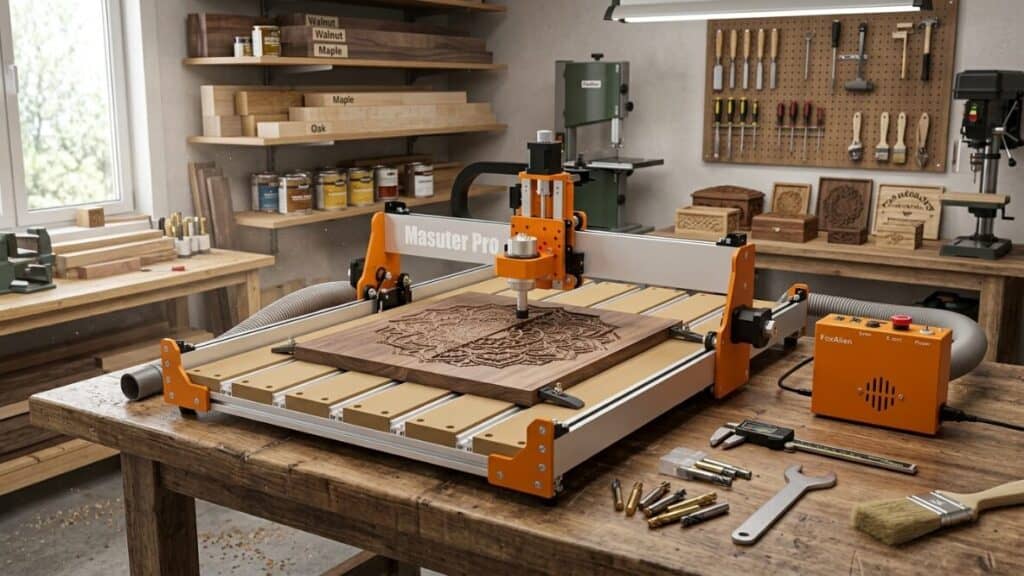
⚡ Quick Verdict
The FoxAlien Masuter Pro is a frustratingly capable CNC router that punches above its price point in raw specifications while underdelivering on refinement and support. After eight months of cutting wood, plastics, aluminum, and even attempting steel, I’ve developed a respect tinged with caution. The 400×400×75mm work area matches the Genmitsu 4040-PRO, the 300W spindle and steel linear rails promise serious capability, and the sub-$600 price undercuts most competitors. But the assembly is a puzzle with missing pieces, the documentation is a translation disaster, the controller has maddening quirks, and FoxAlien as a brand feels one supply chain hiccup away from vanishing. If you’re technically fearless, price-sensitive, and view troubleshooting as part of the hobby, the Masuter Pro offers genuine value. If you want reliability, support, or peace of mind, spend the extra $100–$150 for the Genmitsu 4040-PRO. My rating: 3 out of 5 stars. Powerful specs, patchy execution.
See Our List of Best CNC machines for woodworking in 2026.
Table of Contents
Why I Bought the FoxAlien Masuter Pro (And Why I Was Intrigued)
I’ve tested CNC routers across the spectrum—from $200 LUNYEE clones to $700 Genmitsu 4040-PRO machines to $2,000+ professional setups. A reader kept insisting the Masuter Pro was “the best-kept secret in budget CNC,” claiming it matched Genmitsu specs at LUNYEE prices. I was skeptical but curious.
FoxAlien is a relatively new name, primarily known for laser engravers that get mixed reviews. Their CNC entry seemed like a natural extension, but I wondered if they understood machining or were just rebranding generic Chinese frames.
I paid $549 on a promotional sale—$150 less than the Genmitsu 4040-PRO’s regular price. My expectation: a machine that looked impressive on paper but revealed corners cut in assembly, components, or support. My hope: that the reader was right and I’d found a genuine value outlier.
What I got was something between those poles—a machine with real capability wrapped in real frustration.
FoxAlien Masuter Pro Specifications and Features
| Feature | Spec |
|---|---|
| Work Area | 400 × 400 × 75 mm (X × Y × Z) |
| Frame | All-aluminum extrusion + steel plates |
| Linear Motion | Steel linear rails (X, Y), ball screw (Z) |
| Drive System | T8 lead screws (X, Y), SFU1204 ball screw (Z) |
| Stepper Motors | NEMA 23, 2A |
| Spindle | 300W brushless DC motor |
| Spindle Speed | 10,000–24,000 RPM |
| Collet | ER11 (1/8-inch standard, 1/4-inch adapter included) |
| Controller | GRBL 1.1f, 32-bit ARM processor |
| Connectivity | USB + offline controller (included) |
| Limit Switches | X, Y, Z (mechanical, pre-wired) |
| Software | FoxAlien CAM (included), Candle, UGS, bCNC, Fusion 360 |
| Weight | 40 lbs (assembled) |
| Power Supply | 24V 10A |
| Price | ~$549–$649 |
Unboxing and Assembly: A Test of Patience and Detective Work
The Masuter Pro arrived in two boxes with foam packing. First impression: the components look quality. Thick aluminum extrusions, machined steel plates, actual linear rails with bearing blocks. This isn’t a flimsy 3018 rebrand.
Then I opened the manual.
It’s a translation disaster. Sentences that make no sense. Steps referenced in wrong order. Diagrams that don’t match the actual parts. One page describes installing the “Y-axis motor” with an illustration showing the X-axis. Another references a “spindle cooling fan” that doesn’t exist on this model.
Assembly took 14 hours across four days—longer than the Genmitsu 4040-PRO, and not because the machine is more complex. I spent hours:
- Deciphering the manual: Cross-referencing YouTube videos, Reddit posts, and FoxAlien’s sparse online documentation
- Identifying mystery parts: Several bags weren’t labeled in the manual. I eventually figured out they were spare hardware and cable management clips
- Fixing pre-assembly errors: The Z-axis ball screw was installed with excessive preload, causing binding. I had to disassemble and adjust
- Troubleshooting dead electronics: The offline controller wouldn’t power on. Traced to a loose internal connector I had to open the housing to fix
Once assembled, the machine felt solid. But the journey there tested my patience more than any CNC I’ve built.
FoxAlien Masuter Pro Performance Test: Pushing the Specs
Wood and MDF: Capable When Calibrated
The Masuter Pro handles wood confidently once dialed in. The steel linear rails and ball screw Z-axis provide rigidity comparable to the Genmitsu 4040-PRO.
Settings for 3/4-inch MDF sign:
- Feed rate: 1,600 mm/min
- Plunge rate: 500 mm/min
- Depth per pass: 2.5 mm
- Spindle speed: 18,000 RPM
- Bit: 1/4-inch 2-flute carbide end mill
Results were good—not quite Genmitsu crisp, but close. Slight edge fuzzing required more sanding than the 4040-PRO produces. I suspect minor frame flex or rail alignment issues.
Hardwoods (walnut, maple, 1-inch stock):
- Feed rate: 1,000 mm/min
- Depth per pass: 1.5 mm
- Results: Clean edges, no burning, but occasional chatter marks on end grain that the Genmitsu avoids
The 300W spindle has adequate torque, but the controller’s acceleration settings felt conservative out of box. I increased them after consulting online forums, improving performance but introducing occasional lost steps on rapid moves. Tuning became a balancing act.
Acrylic and Plastics: Solid Performer
Plastics machine well on the Masuter Pro. The 300W spindle and rigid frame prevent the melting issues that plague 3018 machines.
Settings for 1/2-inch cast acrylic:
- Feed rate: 1,800 mm/min
- Plunge rate: 600 mm/min
- Depth per pass: 2 mm
- Spindle speed: 24,000 RPM
- Bit: Single-flute upcut spiral
Clean edges, minimal chip welding, good enough for functional enclosures without flame polishing. I produced a series of Arduino project boxes with precise connector cutouts.
HDPE and Delrin: Both cut beautifully. The rigidity prevents the chatter that causes poor finishes on flexible materials.
Aluminum: The Capability Test
This is where the Masuter Pro’s specs meet reality. The frame and spindle are theoretically capable, but execution details matter.
Settings for 1/4-inch 6061 plate:
- Feed rate: 500 mm/min
- Plunge rate: 150 mm/min
- Depth per pass: 0.15 mm
- Spindle speed: 24,000 RPM
- Bit: 1/8-inch single-flute carbide
- Lubrication: WD-40 mist
Results were acceptable but inconsistent. Some cuts were clean and precise. Others showed slight chatter marks or dimensional variation I traced to:
- Rail alignment: My Y-axis rails weren’t perfectly parallel despite careful assembly, causing binding on certain moves
- Controller tuning: The GRBL parameters needed more aggressive optimization than the Genmitsu required
- Spindle runout: Measured ~0.04mm—double the Genmitsu’s 0.02mm
I machined functional brackets and faceplates, but tolerances hovered around ±0.15mm rather than the ±0.1mm I achieve on the 4040-PRO. For hobby work, this is fine. For parts that must fit together precisely, it’s limiting.
Thicker aluminum (1/2-inch): Possible but slow and occasionally frustrating. The frame shows more flex than the Genmitsu on aggressive cuts, and I had one instance where the Z-axis drifted slightly during a long job—possibly due to the ball screw preload issue I fixed earlier not being fully resolved.
PCB Milling: Overkill but Functional
The Masuter Pro handles PCB isolation milling, but the large work area is unnecessary for most boards. I produced a few prototype panels with 0.5mm trace clearance. Results were adequate but not exceptional—the slightly higher spindle runout made fine traces less consistent than on the Genmitsu.
If PCBs are your primary need, a 3018 is more practical. The Masuter Pro’s strength is larger mechanical work.
Spindle and Mechanical Deep Dive
300W Brushless Spindle
On paper, identical to the Genmitsu 4040-PRO’s spindle. In practice, slightly different:
- Actual power draw: ~270W under load (slightly less than Genmitsu’s ~280W)
- Runout: ~0.04mm (acceptable but not exceptional)
- Noise: Similar moderate hum, quieter than 775 DC motors
- Heat: Runs warm, never concerning
- ER11 collet: Functional, but the included 1/4-inch adapter had poor tolerances. I replaced it with a quality aftermarket collet
The spindle works fine but doesn’t match the Genmitsu’s precision. For most hobby work, the difference is academic. For tight-tolerance parts, it matters.
Steel Linear Rails and Ball Screw
The Masuter Pro uses the same rail and screw types as the Genmitsu 4040-PRO, but execution differs:
- Rail quality: Appears identical—same manufacturer markings, same bearing smoothness
- Installation: My Y-axis rails required shimming to achieve proper parallelism. The Genmitsu’s were parallel out of box
- Ball screw: Came over-preloaded from factory, requiring disassembly and adjustment. The Genmitsu’s was properly set
- Bearing blocks: One Z-axis block had slight roughness that smoothed after 20 hours of use—possible break-in or minor defect
These aren’t catastrophic issues, but they speak to quality control that’s a notch below Genmitsu’s. The machine achieves good performance eventually, but only after hands-on correction.
Controller and Software: Quirks and Workarounds
The Masuter Pro uses a 32-bit ARM controller running GRBL 1.1f—same generation as the Genmitsu. But implementation details create friction:
FoxAlien CAM (included software): Basic and buggy. Crashed twice during my testing. I abandoned it within a week.
Standard GRBL compatibility: Candle, UGS, and bCNC all work, but with quirks:
- Homing direction: Reversed from standard GRBL. Required $23 parameter change
- Spindle delay: Longer than ideal between M3/M5. I adjusted post-processor settings
- Soft limits: Pre-configured but wrong for my machine’s actual travel. Had to recalculate and update
- Offline controller: Functional but the screen is lower resolution than Genmitsu’s, making fine adjustments harder to see
The controller works once configured, but getting there required more forum-diving and trial-and-error than any machine I’ve tested.
FoxAlien Masuter Pro Pros and Cons
✅ What I Liked
- Competitive price — $100–$150 less than Genmitsu 4040-PRO
- 400×400mm work area matches larger competitors
- Steel linear rails provide genuine rigidity
- Ball screw Z-axis enables precise depth control
- 300W spindle handles wood, plastics, and light aluminum
- NEMA 23 motors deliver adequate torque
- 32-bit controller supports complex G-code
- All-metal construction feels substantial
- Active online community helps with troubleshooting
❌ What I Didn’t Like
- Atrocious documentation — worst manual of any CNC I’ve assembled
- Quality control inconsistencies — rails, ball screw, spindle all needed adjustment
- Higher spindle runout than competitors
- Controller quirks require extensive parameter tuning
- Included software is unusable — plan on learning standard CAM
- FoxAlien brand uncertainty — limited track record, unclear long-term support
- Offline controller screen is low-resolution and frustrating
- No meaningful customer support — emails go unanswered
- Resale value concerns — unknown brand, no established market
FoxAlien Masuter Pro vs. Competitors
vs. Genmitsu 4040-PRO
This is the comparison that matters. The machines share nearly identical specifications but differ significantly in execution:
| Factor | Masuter Pro | Genmitsu 4040-PRO |
|---|---|---|
| Price | $549–$649 | $649–$749 |
| Assembly | 14+ hours, manual issues | 12 hours, better docs |
| Out-of-box precision | Required tuning | Near-ready |
| Spindle runout | ~0.04mm | ~0.02mm |
| Controller quirks | Multiple | Minimal |
| Support | Essentially none | Responsive, helpful |
| Community | Growing but small | Established, large |
| Long-term confidence | Low | Moderate |
The Genmitsu costs $100–$150 more but delivers that value in reduced frustration, better precision, and actual support. For most buyers, it’s the smarter choice.
Winner: Genmitsu 4040-PRO (for reliability); Masuter Pro (for price and technical challenge)
vs. LUNYEE 3018 PRO MAX
Different categories, but both are budget-focused. The Masuter Pro’s larger work area, linear rails, and ball screw put it in a different league. The LUNYEE’s 500W spindle is more powerful but the 3018 frame is limiting. If you can afford the Masuter Pro, skip 3018s entirely.
Winner: FoxAlien Masuter Pro
vs. Shapeoko 4
Not a fair fight. The Shapeoko costs 3x more and offers professional-grade everything. But the gap is smaller than with 3018s. The Masuter Pro’s linear rails and ball screw approach Shapeoko mechanical quality, while the controller and spindle remain hobby-grade.
Winner: Shapeoko 4 (for professionals); Masuter Pro (for budget-conscious makers)
Who Should Buy the FoxAlien Masuter Pro?
Buy the Masuter Pro if:
- You want 4040-class capability at 3018-class prices
- You’re technically confident and enjoy troubleshooting
- You don’t need customer support and can self-service
- You view CNC as a tinkering hobby as much as a production tool
- Your budget is strictly under $600
- You have patience for assembly and calibration
- You already know standard GRBL software and don’t need hand-holding
Skip the Masuter Pro if:
- You want reliable out-of-box performance
- You need customer support or warranty confidence
- You’re a CNC beginner — the learning curve is punishing
- You can stretch to $700 for the Genmitsu 4040-PRO
- You value precision and repeatability over raw specs
- You need production reliability for selling your work
- You want a brand with established reputation and community
Essential Upgrades and Fixes
Budget time and money for:
- Quality collets and nut: The included ER11 components are adequate; aftermarket precision collets improve runout
- End mill assortment: 1/8-inch and 1/4-inch for different materials
- Spoilboard and workholding: Essential for 400×400mm work area
- Dust collection: The Masuter Pro makes serious chips
- Cable management improvements: The included drag chains are functional but add friction
- GRBL parameter optimization: Plan on 5–10 hours of tuning for best performance
- Better offline controller or PC tethering: The stock controller screen is frustrating
Long-Term Durability: 8-Month Report
Eight months reveals a machine that’s holding up mechanically but showing software/controller concerns:
- Linear rails: Still smooth after initial break-in
- Ball screw: Required early adjustment, now stable
- Spindle: Consistent power, no bearing issues
- Frame: No flex increase, still square
- Controller: One unexplained reset during a long job, possibly heat-related
- Electronics: The loose connector I fixed in assembly hasn’t recurred, but I don’t trust the solder quality
I expect 3–5 years of hobby use with maintenance, but with less confidence than the Genmitsu. The controller is my biggest concern—if it fails, FoxAlien’s support is uncertain.
Final Thoughts: The Gambler’s CNC
The FoxAlien Masuter Pro is a machine for a specific type of maker: someone who views the tool itself as part of the project, who finds satisfaction in diagnosing and solving problems, who accepts that “working eventually” is acceptable.
I’ve made genuinely good work on this machine. Wooden signs that sold at craft fairs. Aluminum brackets that fit perfectly. Plastic enclosures that house functioning electronics. The capability is real.
But every project started with uncertainty. Would the homing sequence work today? Had the GRBL parameters held? Would the spindle runout cause issues on this precise cut? The Genmitsu 4040-PRO faded into the background and let me focus on my work. The Masuter Pro demanded attention before every job.
If $150 savings matters more than peace of mind, the Masuter Pro delivers. If your time and sanity have value, the Genmitsu is worth the premium.
For me, the Masuter Pro will remain in my workshop as a secondary machine—capable enough for overflow work, but not trusted for critical projects. It taught me that specs tell only part of the story, and that refinement costs money for good reason.
FoxAlien Masuter Pro Review Score
| Category | Rating |
|---|---|
| Value for Money | ⭐⭐⭐⭐ |
| Work Area | ⭐⭐⭐⭐ |
| Build Quality (Design) | ⭐⭐⭐⭐ |
| Build Quality (Execution) | ⭐⭐⭐ |
| Spindle Performance | ⭐⭐⭐ |
| Rigidity and Precision | ⭐⭐⭐½ |
| Ease of Assembly | ⭐⭐ |
| Documentation | ⭐ |
| Controller and Software | ⭐⭐⭐ |
| Cutting Performance (Wood/Plastic) | ⭐⭐⭐⭐ |
| Cutting Performance (Aluminum) | ⭐⭐⭐ |
| Long-Term Reliability Confidence | ⭐⭐½ |
| Overall Enjoyment | ⭐⭐⭐ |
Overall Rating: ⭐⭐⭐ (3/5)
Would I buy the FoxAlien Masuter Pro again? Hesitantly, yes—but only because I enjoy the mechanical puzzle. Would I recommend it to most makers? Only with heavy warnings and only to the technically fearless. For every other buyer, save the extra $100 and buy the Genmitsu 4040-PRO.
Have you taken a chance on an unknown-brand CNC? Did the gamble pay off or leave you frustrated? I’d love to hear your budget CNC stories in the comments.
